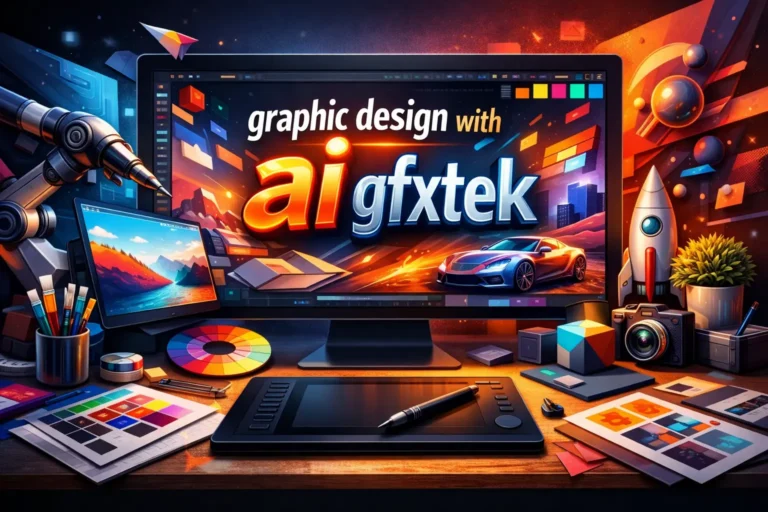
If you want stronger visuals without dragging every project through a long production cycle, graphic design with ai gfxtek is a useful phrase to understand. Across current web references, it is being used less like the name of one fixed software product and more like a practical label for a modern design style: fast concept building, quick variations, textured visuals, cleaner revisions, and human-led finishing. On GFXTek’s own site, the phrase appears as a design topic, and a recent explainer frames it as a workflow built around speed, variation, and polished output rather than a single locked tool.
That matters for blog owners, agencies, startups, and personal brands. You no longer need to begin every banner, cover image, product mockup, social post, or ad concept from a blank canvas. You can start with a rough visual direction, generate multiple options fast, then shape the final result with your own judgment, taste, and brand standards. That is the real value behind graphic design with ai gfxtek: not replacing design thinking, but cutting the heavy manual load so more time goes into message, layout, clarity, and conversion.
A lot of people misunderstand this kind of workflow. They assume speed means lower quality. In practice, speed only becomes a problem when the process is careless. When the process is structured, faster production can actually improve the final output. You can test more angles, compare more compositions, try more colors, and reject weak drafts early. That gives you more room to refine what truly works.
For article writers, marketers, and blog publishers, this matters even more because content demand never stops. A single article may need a featured image, section visuals, Pinterest pins, social crops, quote cards, thumbnails, infographics, and branded promotional assets. Doing all of that manually can slow publishing. A better workflow lets you keep quality while moving faster.
What graphic design with ai gfxtek really means
Quick Bio
| Element | Details |
|---|---|
| Article Title | graphic design with ai gfxtek for Faster Brand Visuals |
| Focus Keyword | graphic design with ai gfxtek |
| Search Intent | Informational |
| Content Type | Long-form blog article |
| Target Audience | Bloggers, marketers, business owners, designers |
| Main Topic | Faster and smarter visual content workflow |
| Primary Benefit | Helps readers create polished branded visuals more efficiently |
| Recommended URL Slug | /graphic-design-with-ai-gfxtek/ |
| Suggested Word Count | 2000+ words |
| Tone | Human, practical, readable, professional |
The phrase graphic design with ai gfxtek is best understood as a hybrid creative workflow. It combines human direction with prompt-based image generation, fast layout ideation, automated style exploration, smart editing, and manual finishing. It is not just “make an image in one click.” It is a system.
In that system, the machine handles the repetitive or time-heavy stages first. That includes rough image generation, background extensions, texture creation, style variations, simple composition ideas, and mass experimentation. The human then takes control of the parts that make the work feel intentional: hierarchy, storytelling, readability, branding, relevance, and emotional tone.
That is why this approach is growing. It removes the slowest parts of visual production without removing the need for creative judgment. A brand still needs a voice. A blog still needs trust. A landing page still needs structure. A campaign still needs consistency. None of that comes from automation alone. It comes from decisions.
So, when people use the term graphic design with ai gfxtek, they are usually talking about a workflow with five main traits: fast draft creation, multiple concept variations, stronger texture and visual depth, easy iteration, and human-led polish at the end. A recent web guide on the topic highlights those same ideas by contrasting traditional long-form design time with quicker concept testing, faster revisions, and a stronger focus on creative direction.
Why this workflow is becoming valuable for blogs and brands
The biggest reason this method is gaining traction is simple: content volume has gone up. A business that once needed one poster now needs ten assets across several channels. A blog post that once needed one banner now needs multiple sizes for social sharing, search appearance, newsletter use, and pin-friendly promotion. The pressure is not only to design well, but to design repeatedly.
That is where graphic design with ai gfxtek becomes practical. It helps teams move from idea to draft much faster. That speed is useful in editorial work because timing matters. If a blog post is ready but the supporting creative is delayed, the whole content pipeline slows down. A faster visual workflow keeps publishing on schedule.
The second reason is testability. Better performance usually comes from better testing. You can compare three thumbnail styles, four hero concepts, two quote card layouts, or several brand color directions without rebuilding every version from scratch. More testing gives you better odds of landing on the right visual angle.
The third reason is creative momentum. One of the hardest parts of design is getting started. When there are no early concepts, the blank canvas feels heavy. A fast-draft system reduces that friction. You can react to something on screen, fix it, reject it, improve it, and move forward. Creative momentum is often what turns a stalled project into a finished one.
The real advantages behind the process
The first clear advantage is time efficiency. A task that used to take hours in raw concepting can be shortened into minutes for the first draft phase. That does not mean the final result takes minutes. It means the first draft arrives sooner, so refinement starts sooner.
The second advantage is variation. One concept is fragile. Five concepts give you options. With a flexible workflow, you are not trapped by your first idea. You can test minimal, bold, textured, soft, editorial, geometric, or product-led directions before choosing the strongest one.
The third advantage is visual depth. Texture, lighting, layered surfaces, reflective materials, grain, paper effects, depth blur, metallic tones, and dimensional styling can take a lot of manual effort. Modern image-generation systems are especially strong at building rich visual surfaces quickly. That makes them useful for posters, hero sections, gaming-style visuals, promotional creatives, and mood-led branding pieces.
The fourth advantage is scale. Once you lock a direction, it becomes easier to produce matching assets. The goal is not to create random visuals. The goal is to build a repeatable style system. That is what makes this workflow useful for businesses, not just hobbyists.
The tools shaping this space right now
No serious design workflow runs on one tool alone. Strong output comes from combining tools based on the stage of work.
Adobe Firefly is important because it is built around generation and editing inside a professional ecosystem. Adobe says Firefly can generate images, video, audio, and designs, and that its newer image models improve prompt interpretation and text accuracy in images. Adobe also says Firefly supports more than 100 languages for text prompts, and it states that Creative Cloud subscribers’ personal content is not automatically used to train Firefly. That combination matters for teams that care about workflow depth, language flexibility, and brand safety.
Canva’s Magic Design is important because it is aimed at speed and editability. Canva describes it as a tool that auto-generates designs from your text and media, then gives you refined templates that are still editable. That makes it useful for blog banners, social graphics, email visuals, simple presentations, and quick promo assets where speed and easy editing matter more than deep compositing.
Recraft stands out because it focuses heavily on vector-friendly production. Its official page says it can create sharp SVG vectors and illustrations, then export in SVG, PNG, JPG, or Lottie. It also highlights color editing, detail control, background cleanup, and upscale steps inside the workflow. For logo drafts, icons, ad graphics, posters, and scalable brand assets, that makes Recraft especially useful.
Midjourney remains strong for mood, texture, concept visuals, and stylized image direction. Its documentation states that V7 was released on April 3, 2025, became the default on June 17, 2025, and improved prompt precision along with richer textures and more coherent detail. That makes it valuable for ideation and visual exploration when you need striking draft directions before moving into editing software.
These tools do different jobs. One handles deep editing well. One handles fast templates well. One handles vector output well. One handles rich concept imagery well. The best workflow is usually a combination, not a single platform.
How to use graphic design with ai gfxtek in a clean workflow
A strong workflow begins with creative intent, not software. Before touching any tool, define the job clearly. What are you making? A featured image? A blog banner? A thumbnail? A promo card? A product insert? A header graphic? If the purpose is unclear, the result becomes vague fast.
Next, define the visual goal. Choose the message, audience, emotional feel, and content role. Should the design feel premium, playful, bold, minimal, editorial, luxury, tech-led, soft, or urgent? This stage shapes the prompt, the composition, and the final polish.
Then create rough visual drafts. This is the idea phase. Generate several possible directions quickly. Do not chase perfection yet. You are trying to discover composition, tone, color balance, and image potential.
After that, move into selection. Pick one or two directions that actually match the content goal. Remove weak ideas early. A fast workflow only stays efficient when you cut bad options quickly.
Now comes the most important part: editing. Bring the strongest draft into your design software and start refining. Fix edges. Improve contrast. Clean visual noise. Add spacing discipline. Correct layout imbalance. Insert readable typography. Align the design with the brand style. This is where raw output becomes professional output.
Then build variations. Once the main design is solid, produce alternate crops and supporting assets. Turn the same visual direction into a wide banner, a square social post, a pin image, an email header, or a thumbnail. This is where the system becomes productive.
Finally, review with intention. Ask if the design communicates clearly. Ask if it looks branded. Ask if the text is readable at small size. Ask if it supports the article rather than distracting from it. A polished visual is not just attractive. It is useful.
That complete process is the practical side of graphic design with ai gfxtek. It is not about clicking once and publishing. It is about reducing draft time, then investing your effort in the parts that shape trust and performance.
How brand consistency stays intact
A common fear is that fast-generated visuals will look random. That only happens when there is no system. Brand consistency is still fully possible when you control the right inputs.
Start with a fixed style foundation. Use a defined palette, a clear font pairing, repeatable spacing rules, and a small set of texture directions. If your site uses warm neutrals, do not switch to neon-heavy visuals for no reason. If your brand is clean and minimalist, do not suddenly use chaotic layered effects. The faster your production gets, the more disciplined your style rules need to be.
Use reference visuals. One strong reference image can keep a whole asset set aligned. Repeat the same texture family, lighting direction, framing style, and composition rhythm. That turns a loose set of drafts into a recognizable content system.
Keep editing human-led. Even when the first draft is machine-assisted, the final form should still be reviewed manually. This is how you keep typography readable, spacing balanced, and visual hierarchy clear. Clean finishing is what separates a content factory from a trusted brand.
Official tool pages are increasingly built around this need for consistency. Leonardo highlights control over color, typography, and visual style, while also emphasizing repeatable design systems and consistent output across campaigns. That matches the real business need: not random images, but coherent branded assets.
Where this works best for blog websites
This workflow is especially useful for featured images. A blog post title becomes stronger when the visual immediately supports the topic and tone. A custom image often performs better than a generic stock asset because it feels more specific and memorable.
It also works well for section graphics. Long-form posts are easier to read when the design breaks the page visually. Small supporting visuals can guide the reader from one section to the next.
Pinterest graphics are another strong use case. Vertical visuals need quick adaptation from the main article design. A repeatable design process makes that easy.
Quote cards, checklist graphics, promotional snippets, category thumbnails, and email headers also benefit from the same system. The more often you publish, the more valuable a repeatable visual engine becomes.
For affiliate or product-driven blogs, this method also helps create comparison banners, themed category graphics, soft mockups, and branded promo visuals at scale. That does not remove the need for product accuracy, but it makes supporting design work much faster.
Common mistakes that ruin the result
The first mistake is trusting the first draft too much. Early drafts are raw. They are meant to be shaped. Publishing them too quickly leads to weak brand alignment and a generic look.
The second mistake is over-designing. Fast generation makes it easy to pile on too many effects. Heavy glow, too much contrast, messy texture, and unclear focal points can make the visual look noisy instead of strong.
The third mistake is ignoring typography. Image quality alone does not make a banner effective. If the headline placement is weak or the text is hard to read, the design fails its main job.
The fourth mistake is chasing novelty over clarity. Just because a design looks dramatic does not mean it supports the article. A good blog visual should match the content, not compete with it.
The fifth mistake is forgetting output format. A wide hero image, a square card, and a vertical pin do not behave the same way. Smart workflows adapt the design for the destination instead of stretching one format everywhere.
Originality, ownership, and ethical use
Any modern design workflow still needs common sense. Use generated drafts as creative material, not as an excuse to copy. Originality still matters. Your tone, your layout, your brand choices, and your editing decisions are what make the result feel like your work.
That is why tool choice matters too. Adobe publicly notes that Firefly does not use Adobe Stock editorial content for training, and it states that customer personal content is not automatically used from Creative Cloud subscriber files. For many businesses, details like that matter when thinking about trust, workflow risk, and brand protection.
A clean rule is simple: never treat generated output as finished truth. Treat it as raw material. Edit it, review it, make it specific, and make it useful. That is how you keep the process responsible and the result stronger.
How to turn this into a repeatable publishing system
If you run a blog website, the smartest move is to build templates around the workflow. Decide on a few repeatable formats. One for featured images. One for Pinterest. One for section graphics. One for quote cards. One for email use.
Then create prompt frameworks for each format. Not one fixed prompt, but a structure. That structure should include subject, tone, color direction, visual depth, framing, and intended use. With a repeatable prompt structure, your drafts become more usable from the start.
Next, build a style guide. Keep headline placement rules, font pairs, color references, and texture notes written down. This reduces decision fatigue and keeps output more consistent.
Then batch your work. Instead of building visuals one by one, create assets in groups. If you are publishing four articles this week, generate and refine the visual drafts for all four in one session. Batching saves time and improves consistency.
Review everything before publishing. Speed is the gain, but review is the protection. The fastest workflow still needs human approval before it goes live.
This is where graphic design with ai gfxtek becomes more than a trendy phrase. It becomes a useful production model for editorial work. It helps you move faster, keep your visual identity tighter, and support more content without letting design become the bottleneck.
Final thoughts
At its best, graphic design with ai gfxtek is not about shortcuts. It is about smarter sequencing. Let the system speed up concepting, variation, and rough production. Then let human judgment handle message, polish, branding, and clarity.
That balance is what makes the method valuable. You get faster drafts, more creative range, better testing, and stronger publishing flow. But the final quality still comes from decisions, not automation.
For a blog website, that is a strong advantage. Better visuals improve presentation. Faster production improves consistency. More variations improve testing. And a clear system makes growth easier to manage.
If you use it with discipline, graphic design with ai gfxtek can help you build a content engine that looks more polished, feels more branded, and supports publishing at a much better pace.
FAQs
What is graphic design with ai gfxtek in simple words?
It is a modern design workflow where fast-generated drafts, prompt-based visuals, and quick variations are used to speed up production, while the final output is still shaped and polished by a human designer.
Is graphic design with ai gfxtek good for blog websites?
Yes. It works well for featured images, Pinterest graphics, social creatives, email headers, section visuals, and branded promo assets. It is most useful when you publish often and need a repeatable visual process.
Do I still need design skills for this workflow?
Yes. Fast tools can generate drafts, but strong results still depend on layout judgment, typography, brand consistency, editing decisions, and knowing what fits the audience.
Which tools are most useful for this type of design work?
Adobe Firefly is useful for generation and editing, Canva Magic Design is useful for quick editable templates, Recraft is strong for vector output, and Midjourney is strong for textured concept visuals and creative exploration.
How many times should I use this workflow in a content system?
As often as it improves speed without lowering quality. The best approach is to use it for draft creation, variation, and scaling, then keep final review and brand-level decisions fully human-led.
Read More: What bigcokc69420 Reveals About Modern Internet Usernames, Meme Culture, and Digital Identity
About the Author