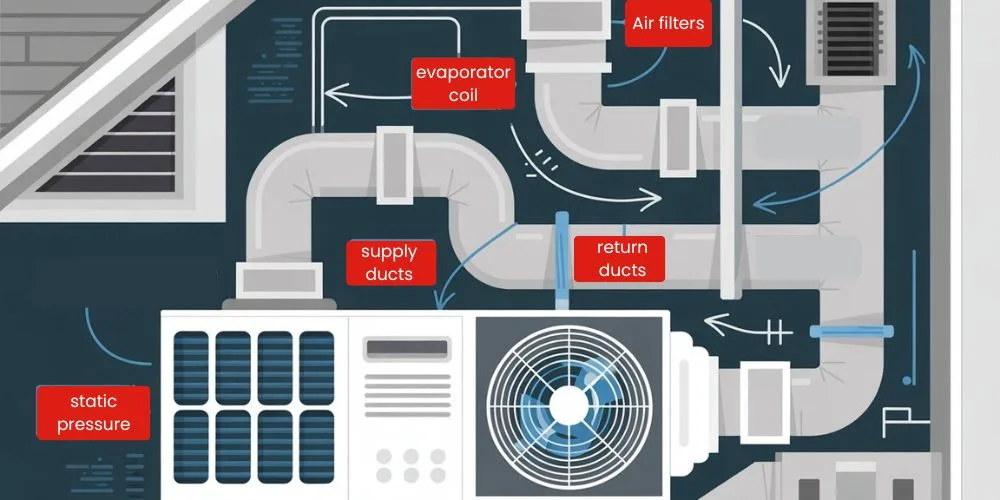
Many HVAC issues look like comfort complaints rather than mechanical failures. A home can feel stuffy in one room, dusty in another, and noisy near the return grille, yet the equipment may still cycle on and off without obvious error codes. Static pressure testing provides clarity by measuring resistance to airflow throughout the duct system and air-handling components. That resistance is often the silent driver behind poor distribution, high energy use, and premature wear on motors and heat exchangers. When pressure climbs above what the system is designed to handle, airflow drops, temperatures drift, and components run hotter than intended. By treating air movement as a measurable performance factor, static pressure turns vague symptoms into a diagnosis that points toward hidden restrictions, undersized ducts, clogged coils, or poorly set blower speeds.
Why Airflow Problems Hide in Plain Sight
- What Static Pressure Measures and Why It Matters
Static pressure is the push back the blower feels as it tries to move air through filters, coils, ducts, grilles, and registers. Think of it as traffic on a highway: the blower can only move so much air if the lanes narrow or blockages pile up. Technicians typically measure total external static pressure, which reflects how the air handler performs against the resistance of the duct system and internal components. The readings are compared to the manufacturer’s rated limits for the equipment. When the pressure is high, the blower may deliver less air than required for heating and cooling to function properly, which can lead to longer run times and temperature imbalances. That is why this test is so revealing: it does not rely on guesswork or a glance at ductwork. It captures how the entire system behaves under real operating conditions. Homeowners who call a Phoenix Air Conditioning Contractor often discover that comfort problems stem from airflow resistance rather than low refrigerant or a failing thermostat, and the pressure readings help prove it.
- Finding Restrictions That Stay Invisible
Static pressure testing shines when problems are buried where no one routinely looks. A filter with too high a resistance, a return grille that is too small, or a flexible duct that is kinked behind a wall can quietly choke airflow for years. The system may still cool, but it does so inefficiently and with more strain. By taking pressure readings at key points, a technician can isolate whether the restriction is primarily on the return side, the supply side, or through the coil and cabinet. A high return pressure often suggests an undersized return path, a clogged filter, a restrictive media cabinet, or a blocked return duct. High supply pressure can indicate undersized supply trunks, closed dampers, crushed flex duct, or overly restrictive registers. Even the evaporator coil can become a hidden culprit as dust and biofilm build up, creating a pressure drop that is not obvious from a quick inspection. The readings guide the next step so the repair is targeted rather than a collection of random guesses.
- Protecting Equipment by Reducing System Stress
When static pressure is high, the blower is forced to work harder to move the same amount of air. In many systems, that extra effort shows up as higher electrical draw, louder operation, and increased heat inside the motor and control compartment. Over time, that stress can shorten the life of blower motors, capacitors, and control boards. High pressure can also affect heating and cooling performance in ways that may appear to be equipment failure. Low airflow across the evaporator coil can lead to colder coil temperatures, which may cause icing and unstable refrigerant pressures. On the heating side, low airflow can raise supply temperatures, triggering limit switches or causing uncomfortable hot blasts followed by short cycling. Static pressure testing helps prevent misdiagnosis by revealing whether the equipment is being asked to operate outside normal airflow conditions. Correcting the airflow problem often restores normal temperature splits and quiet operation without replacing major components. It also reduces the chance that a new part fails early because the underlying airflow restriction was never addressed.
A Single Test That Explains Many Complaints
Static pressure testing is powerful because it connects comfort, efficiency, and equipment longevity to one measurable performance indicator. It reveals hidden restrictions that create uneven temperatures, noisy returns, weak airflow, and stubborn humidity. It also explains why some systems fail sooner than expected, since high resistance forces components to run hotter and longer. By isolating whether the issue sits on the return side, the supply side, or across key internal parts, the test turns a confusing set of symptoms into a focused repair plan. The result is not just better comfort but a system that operates closer to its intended airflow, with less electrical strain and fewer callbacks for the same recurring complaints. For homeowners, that means clearer answers, fewer wasted repairs, and a practical path to lower operating costs. With airflow corrected, the equipment can deliver steadier temperatures, improved filtration, and quieter performance across the home.
About the Author
